A barrel of nails in orbit
A barrel of nails is the cheapest debris weapon there is: put it in low-Earth orbit, open the lid, and let 200,000 nails spread out at orbital speed. I simulated it against every object in orbit. It kills satellites, but it does not start a Kessler cascade. What could is ordinary traffic left in orbit and never brought down.
This is a purely academic study: a valid concern answered with numbers. Don't try this at home: putting debris in orbit on purpose endangers every satellite up there, and it goes against the UN space debris guidelines that spacefaring nations have endorsed.
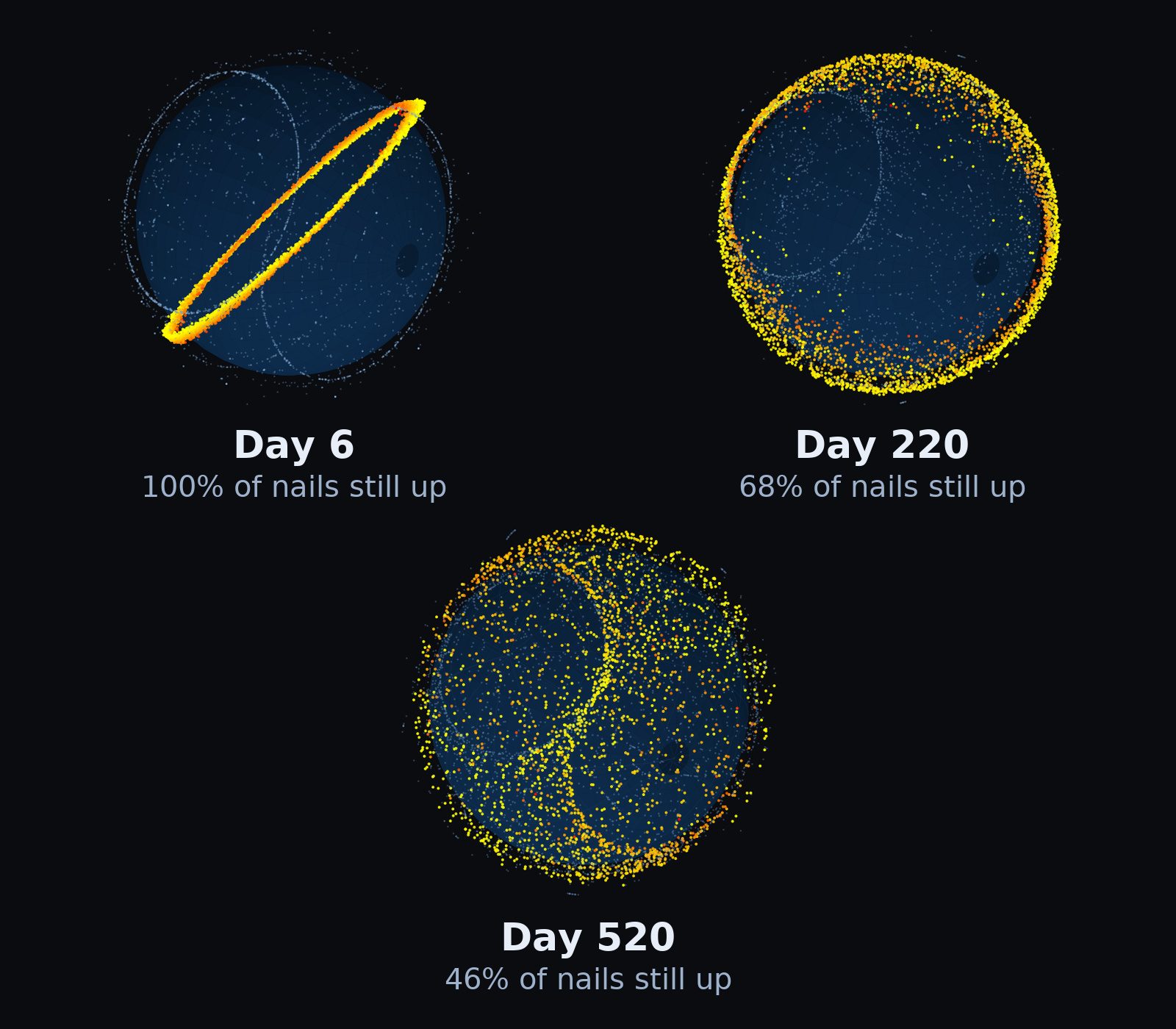
The model
The catalog is the full one from Space-Track: 29,779 objects in low-Earth orbit, each with its own mass and size from its radar cross-section, plus about a million fragments too small to track. The orbits run on a graphics card. Collisions break objects up according to NASA's Standard Breakup Model. Three separate engines evolve the population for 50 years. The main one follows every object on its own orbit, and two objects can only collide where their orbits actually meet. That is the method NASA's LEGEND model uses.
One nail
A 4 g nail at 10 km/s carries about 200 kJ. That kills any satellite it hits. It does not shatter one. Breaking a satellite into a debris cloud takes about 40 joules per gram of its mass, and a nail gives a 260 kg satellite 0.8, fifty times too little. The big clouds come from two large objects colliding. Two 260 kg satellites make about 29,000 fragments.
So the nails kill satellites and add small debris, which slightly raises the odds of the big collisions. They cannot start the chain reaction themselves.
How many barrels
I dumped barrels at 900 km, in the middle of the existing debris belt, and ran 50 years with and without them. Even 1,000 barrels add only about 25% to the objects larger than 10 cm, the ones that feed a cascade. One missile strike on a 1-tonne satellite adds as much as 22 barrels.
Low down it matters even less. Below about 600 km the atmosphere drags debris out within a few years. Between 700 and 1,100 km it stays for decades to centuries. That band is where the old rocket bodies and dead satellites already are.
What does move the belt
To compare, I put every source on one measure: extra objects larger than 10 cm in that band after 50 years.
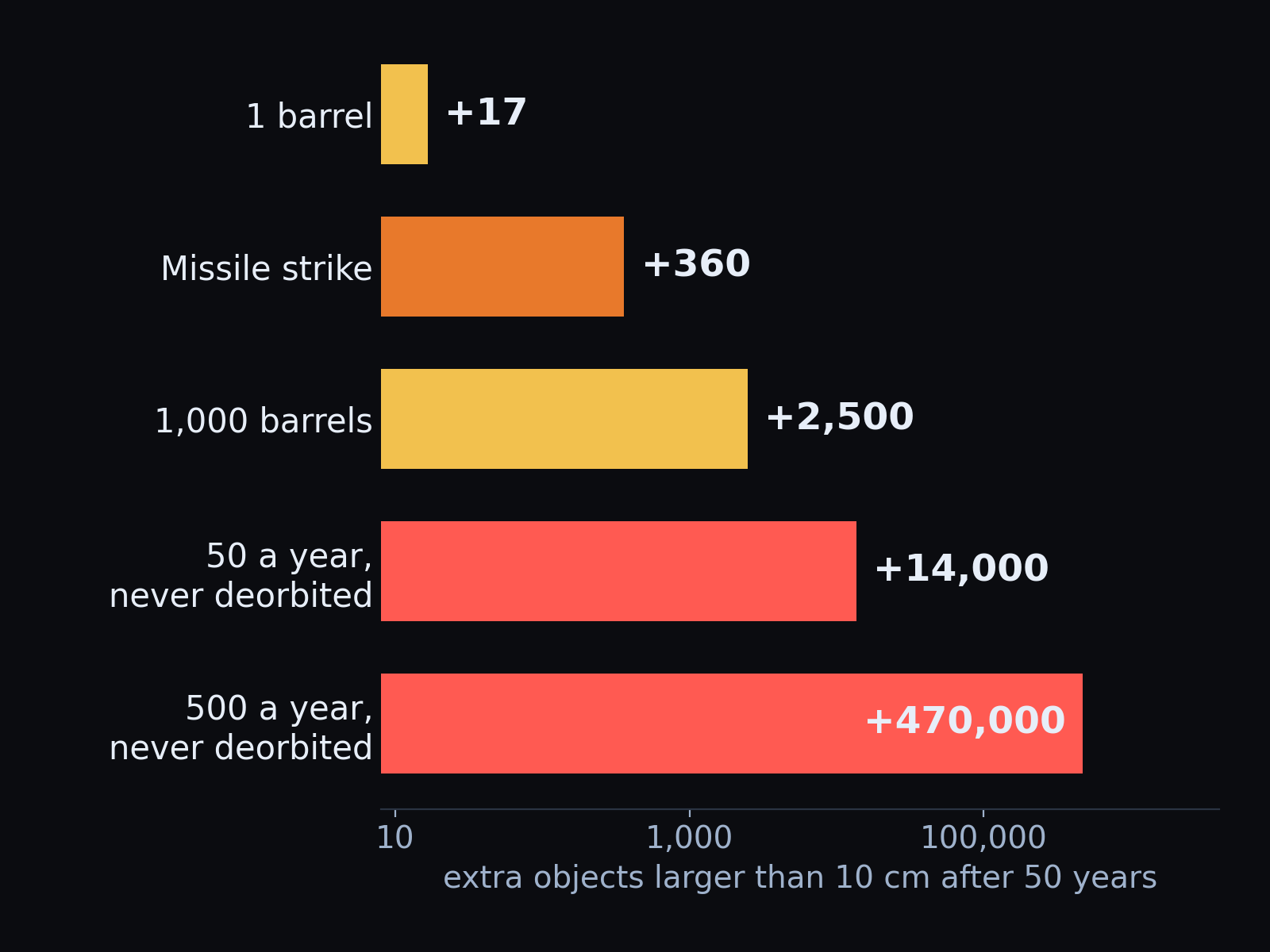
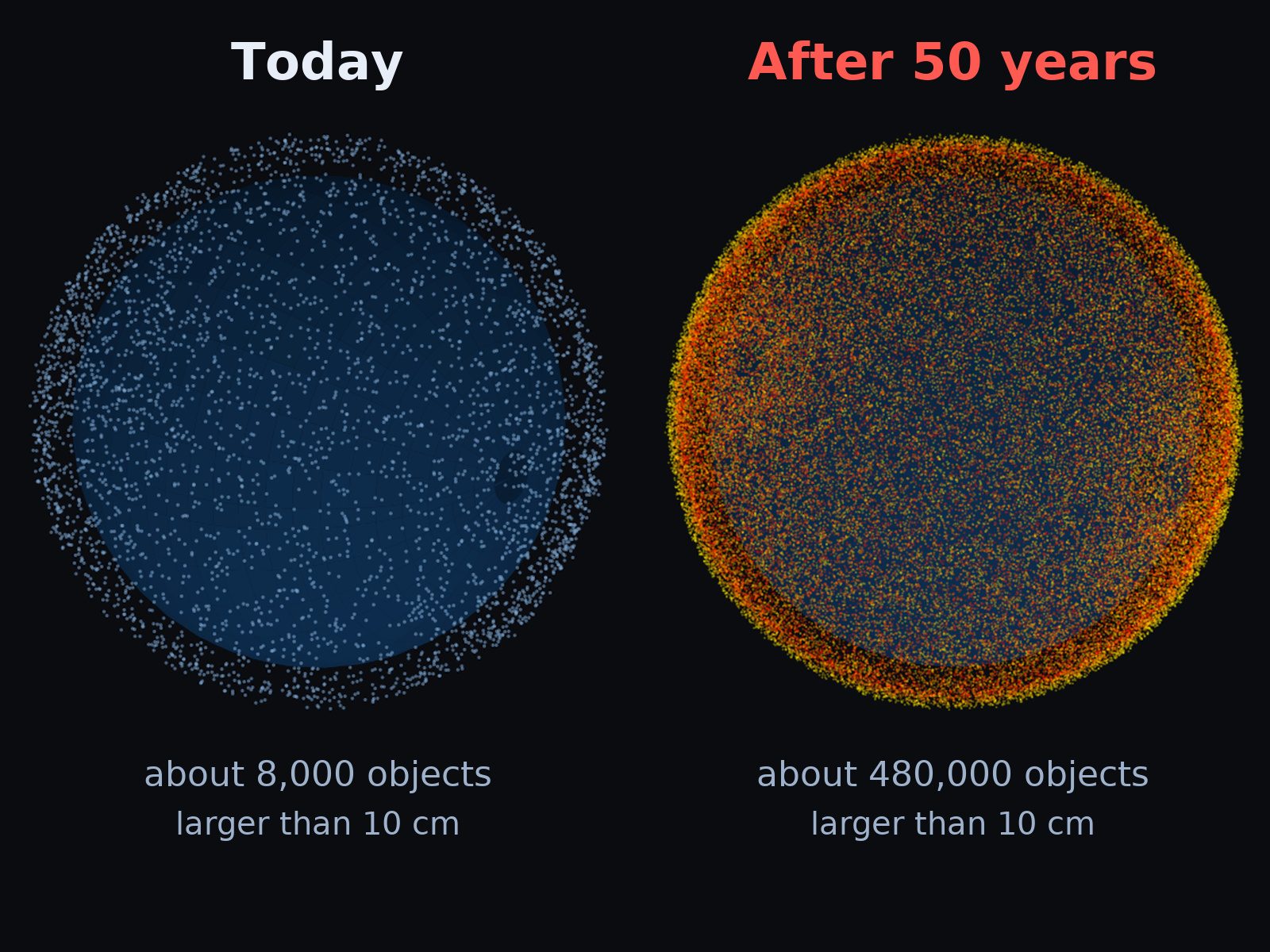
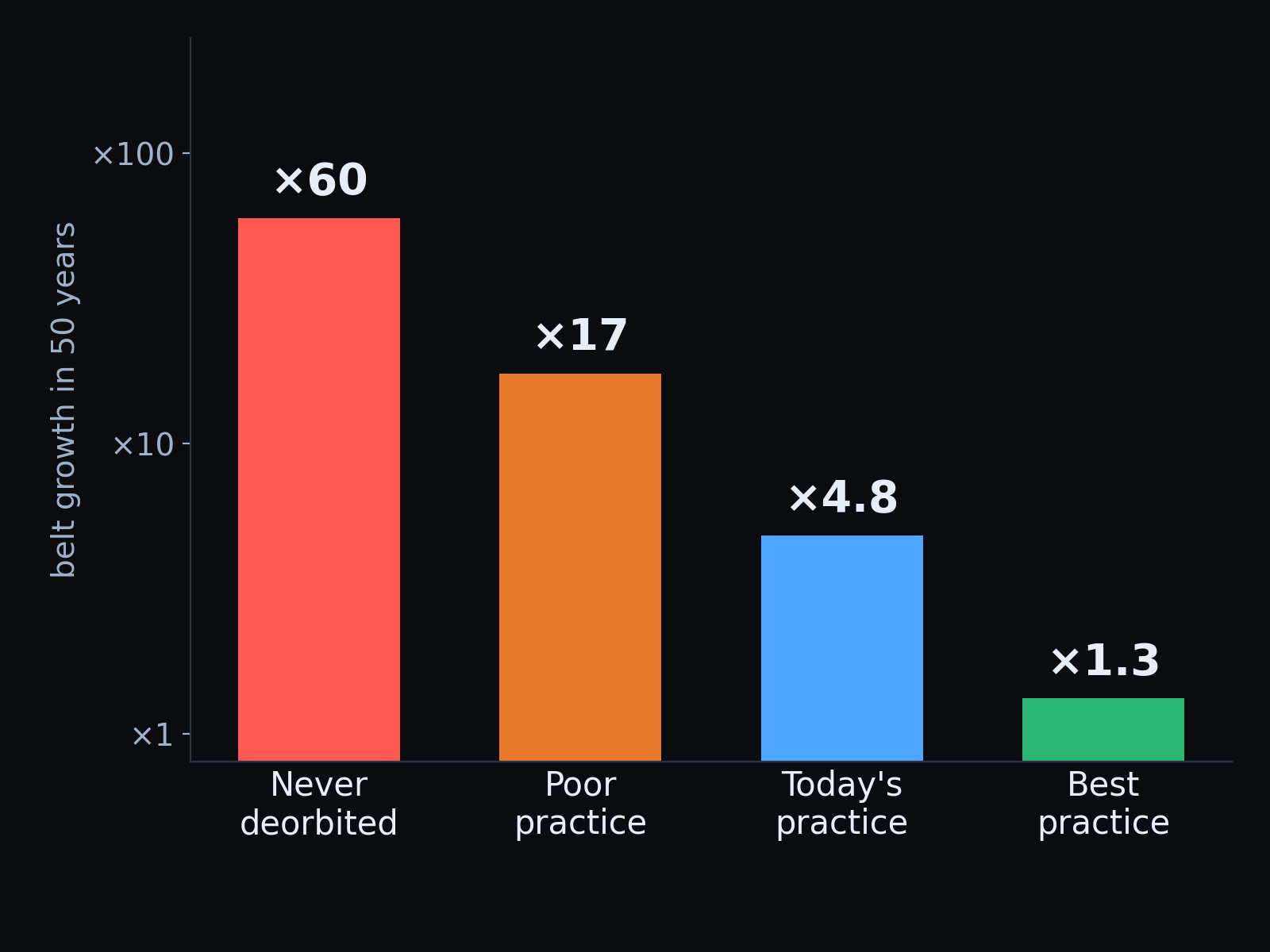
With nothing added at all, the belt still grows about 9% in 50 years. The big numbers come from satellites and rocket bodies left there dead. At 500 a year, none ever deorbited, the belt grows sixty-fold in 50 years. That is a stress test, not a forecast.
Real satellites work for a few years, dodge tracked debris, and are then brought down. With the rates operators reach in practice, 90% of satellites deorbited at the end of their life, the same 500 a year grows the belt 4.8 times instead of 60. Dodging on its own barely helps. What feeds the cascade is the dead satellites left behind, and removing them is what counts.
With nothing new added, taking down about nine of the riskiest large dead objects a year holds the belt flat. With 50 dead satellites a year added it takes about 57. It is a maintenance problem, not a lost cause.
Checking it
In 2006 NASA projected low-Earth orbit 200 years ahead from that year's catalog, with no new launches, and counted about 11 catastrophic collisions (Liou and Johnson, Science). I reran the same case from the same 2006 catalog. My main engine gives 12.8 (7 to 18 across runs), the simpler one 9.9.
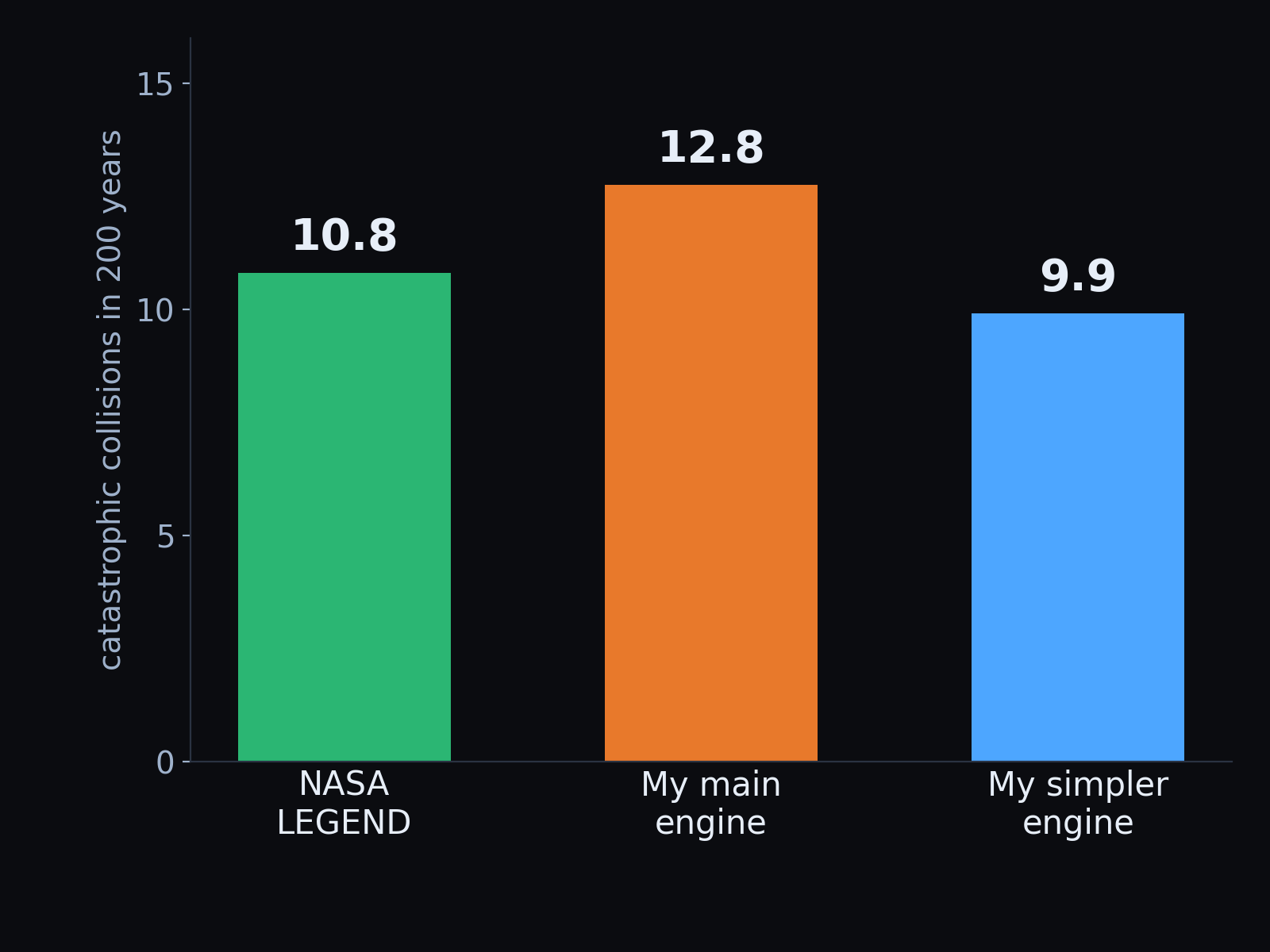
A barrel of nails is a satellite killer and a nuisance at high altitude for decades. It does not end low-Earth orbit. What decides that is how much dead mass is left up there, and how much is taken down.
With responsible policies in place, low-Earth orbit stays usable: satellites and rocket bodies deorbited at the end of their life, which is the decisive lever, and the riskiest large dead objects removed, about nine a year. Collision avoidance helps minimise collision risks for working satellites, while deorbiting and removal keep the debris itself down.
The numbers are order-of-magnitude estimates from a simplified model, not forecasts.
The code, the full study and the presentation are on GitHub.
Reply
Replies come to me first. Tick the box and I may put yours under the post, with your name if you give one.
Comments